

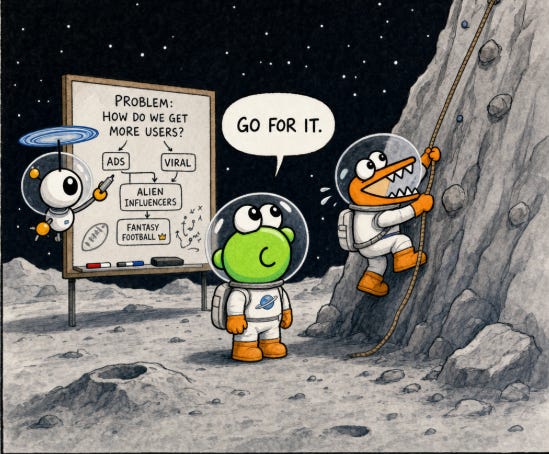
If you are new to being an investor - between saying “Go for it.” and almost anything else, the best thing to say is “Go for it.” — however there are situations where it’s important to present the risks associated with decisions that a founder may not see.
People are always surprised when they find out I’m a parent. They’re even more surprised when they learn I have a twelve-year-old child.
One thing you learn as a parent is that you want your kids to try things, but you don’t want them to get hurt in the process. It’s an odd balance.
What I’ve found myself doing is attempting to articulate the risks of whatever crazy idea they’ve come up with:
“Yes, you can climb that tree, but the downside risk is that a branch breaks, you fall, and you break your butt.”
“Yes, you can try to swim across the entire ocean, but the ocean is large, and there are probably some skills you’ll need to pick up along the way… like knowing how to swim.”
“Yes, you can commit to becoming the best chess player in the world, but you’ll have to close the doors to other opportunities in order to accomplish that goal.”
I think being an investor is remarkably similar to being a parent.
There are two speeds to both investing and parenting:
Say, “Go for it.”
Simplify the risk being taken.
I want to focus on the latter.
As an investor, I find myself having similar conversations with founders.
“Yes, you could try to sell your product to everyone, but that’s like boiling the ocean. There are skills you’ll develop by focusing on one specific customer first.”
“Yes, you could shift from selling to consumers to selling to enterprises, but you only have six months of runway, and it takes six months to close an enterprise customer.”
“Yes, you could launch a $6 million marketing campaign, but then you might end up with a lot of buyers for a product that doesn’t exist yet.”
An investor, at their best, can simplify the risk of a strategy or experiment that a founder wants to pursue.
They give the founder more information without telling them which direction to take.
That is the art.
I’ve watched some of the best investors in the world do this. It’s like watching Picasso paint.
They can take an incredibly complex situation and, with a few sentences, make the risks obvious. Not because they know what the founder should do, but because they know how to frame the decision.
In 2014, I invited Marc Andreessen of a16z to speak at Boost VC. I asked him a lot of questions, but one of them was:
“What’s the best piece of advice you can give a founder?”
He answered almost immediately:
“Don’t take anyone’s advice.”
You can watch the interview here.
As I get deeper into this game of venture capital, I’ve come to believe that this is one of the core principles of great founders. Great founders collect data to make decisions. They don’t blindly take advice.
That doesn’t mean the advice they receive is bad. It doesn’t even mean the advice is wrong. It means the founder has to come to the conclusion themselves.
Which raises an interesting question:
If great founders shouldn’t take anyone’s advice, what exactly is the role of an investor?
I think the answer is to simplify risk.
Help the founder understand the upside. Help them understand the downside. Help them see the trade-offs they might be missing.
And then let them make the decision.
It sounds simple. And in theory, it is simple.
But being able to take something complicated and communicate the risk in a way that anyone can understand is an incredibly difficult skill to master.
The best investors don’t need to be the ones with all the answers.
They need to be the ones who can make the risks clear enough for founders to find their own answers.
Because the goal isn’t to make the decision for someone. It’s to help them make a better decision for themselves and what is best for the company and the universe.
*written by Human. Edited by Ai.
The further I go for it, the more likely it becomes for me to get where you are today.
My current memoir includes asking begging Billionaires to pay a performance psychologist, priests somewhere from the Vatican or some hypnotist to make me the way they are → just to get me where they are with all their flaws & everything. You can’t be Adam Draper without copying the flaws as well.
The further you get down the road with VC, the better you get at foreseeing the risks involved with startup - that's at least what I have found.